Direct Presence: drand round 5717467
Overview
Observed Art (also titled Direct Presence) is a generative artwork that exists at the intersection of cryptography, quantum measurement theory, and real-time web technology. The system produces a continuously evolving particle-based visual field whose behavior fundamentally changes based on whether anyone is watching.
When observers are present, the artwork synchronizes to drand—a decentralized cryptographic randomness beacon—receiving discrete mutation events every few seconds. When no one is watching, the system continues to animate but loses its connection to external structure, drifting aimlessly without punctuation.
This is not a simulation or metaphor. The system measures observation directly through live network connections and responds to verifiable cryptographic events from an independent network. The result is an artwork that enacts core ideas from quantum mechanics and threshold cryptography: observation has consequences without control, and randomness is fundamental rather than emergent.
Visual Evidence: Observed vs. Unobserved States
The difference between observed and unobserved states is visually dramatic. When observers are present, the system maintains coherent flow patterns with distinct color structure and organized particle clustering. When disconnected, the system loses this coherence: patterns become diffuse, colors wash out, and particles wander without directional structure.
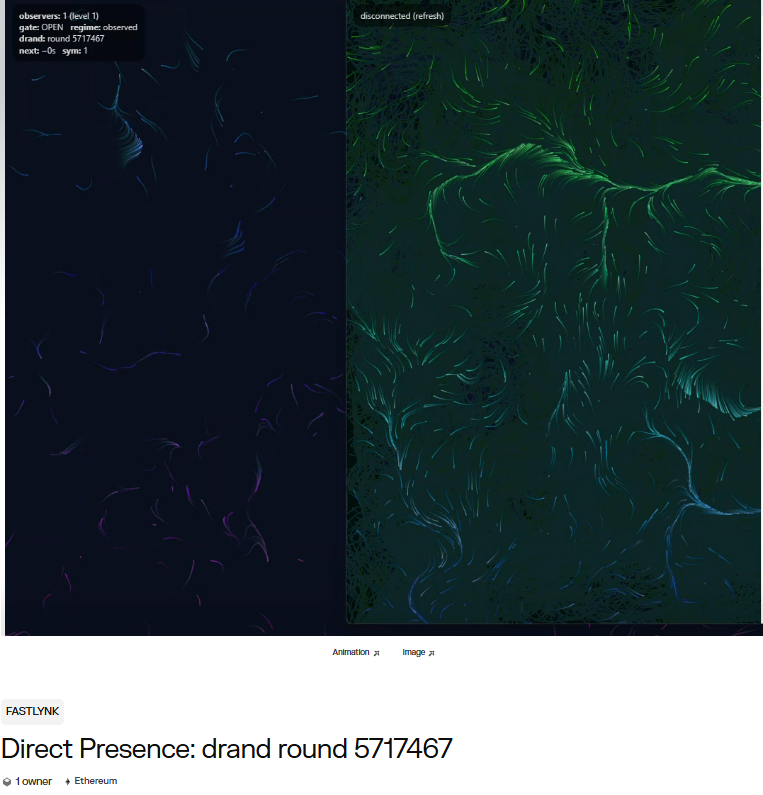
This is the quantum measurement metaphor made visible: observation provides structure, not control. The left side shows discrete events punctuating evolution; the right side shows continuous drift without external anchoring.
Color Diversity Through Cryptographic Randomness
The system discovers its own color moments through the interplay of cryptographic randomness, flow field dynamics, and emergent particle behavior. Every mutation is a unique configuration that has never been seen before and will never repeat.
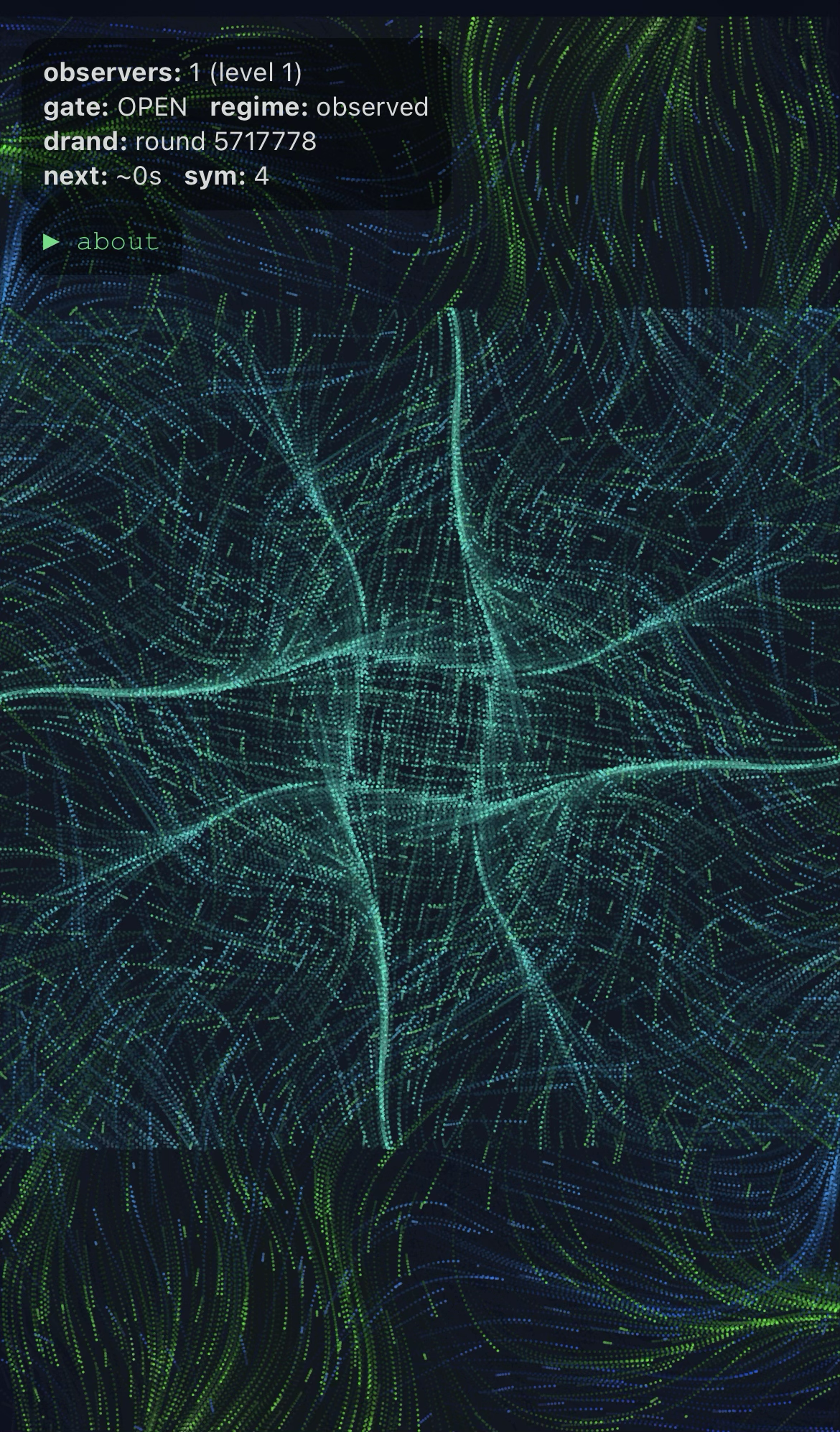
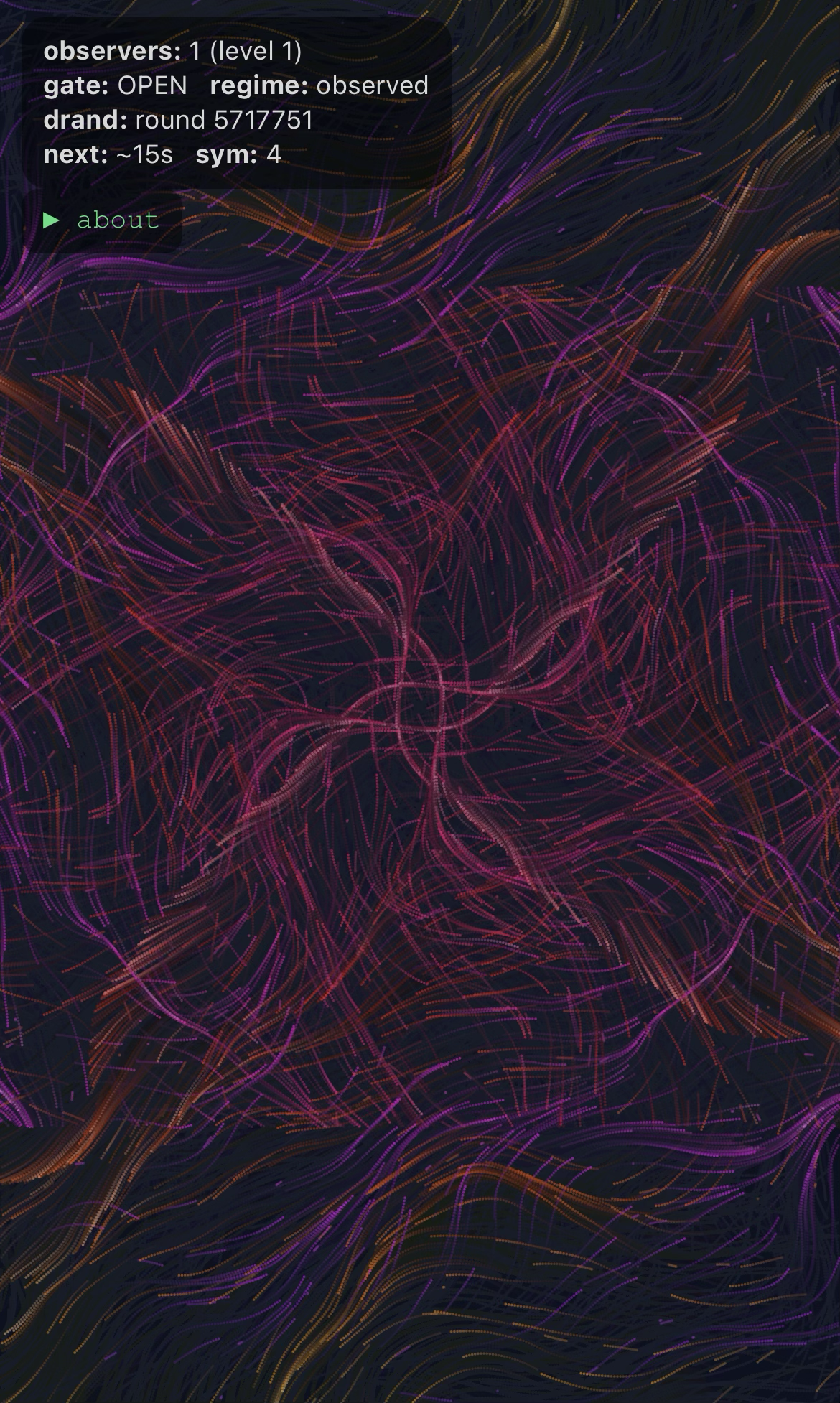
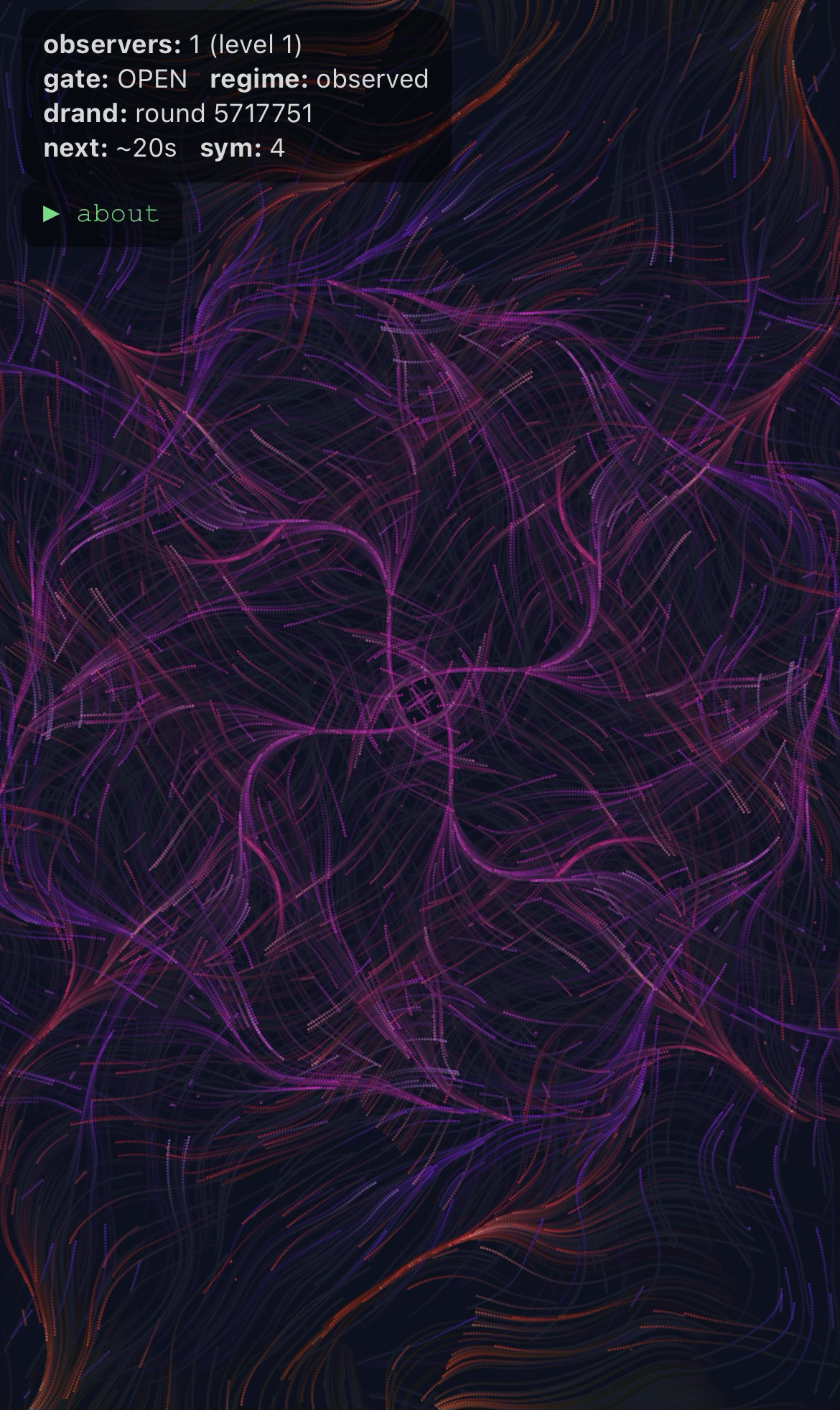
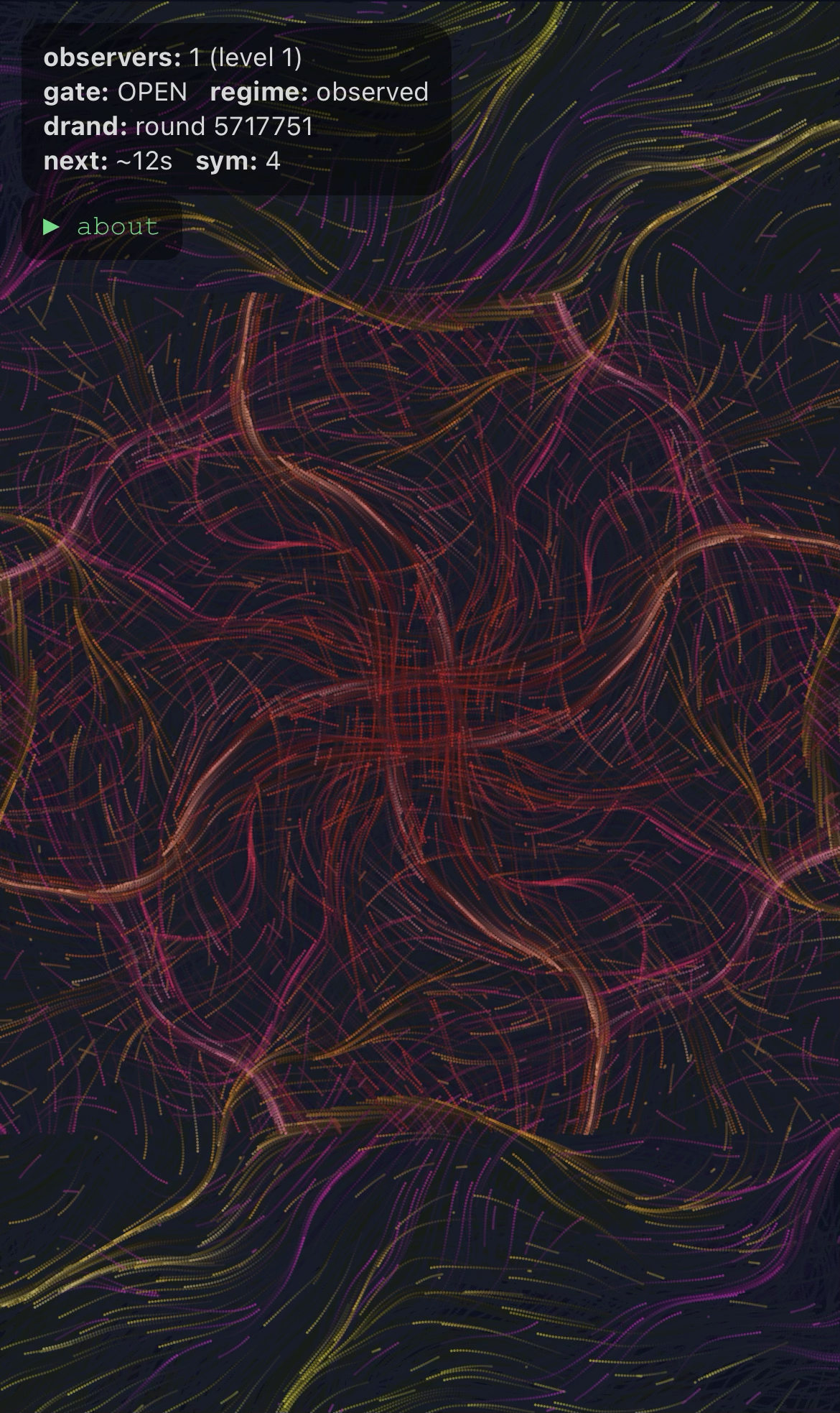
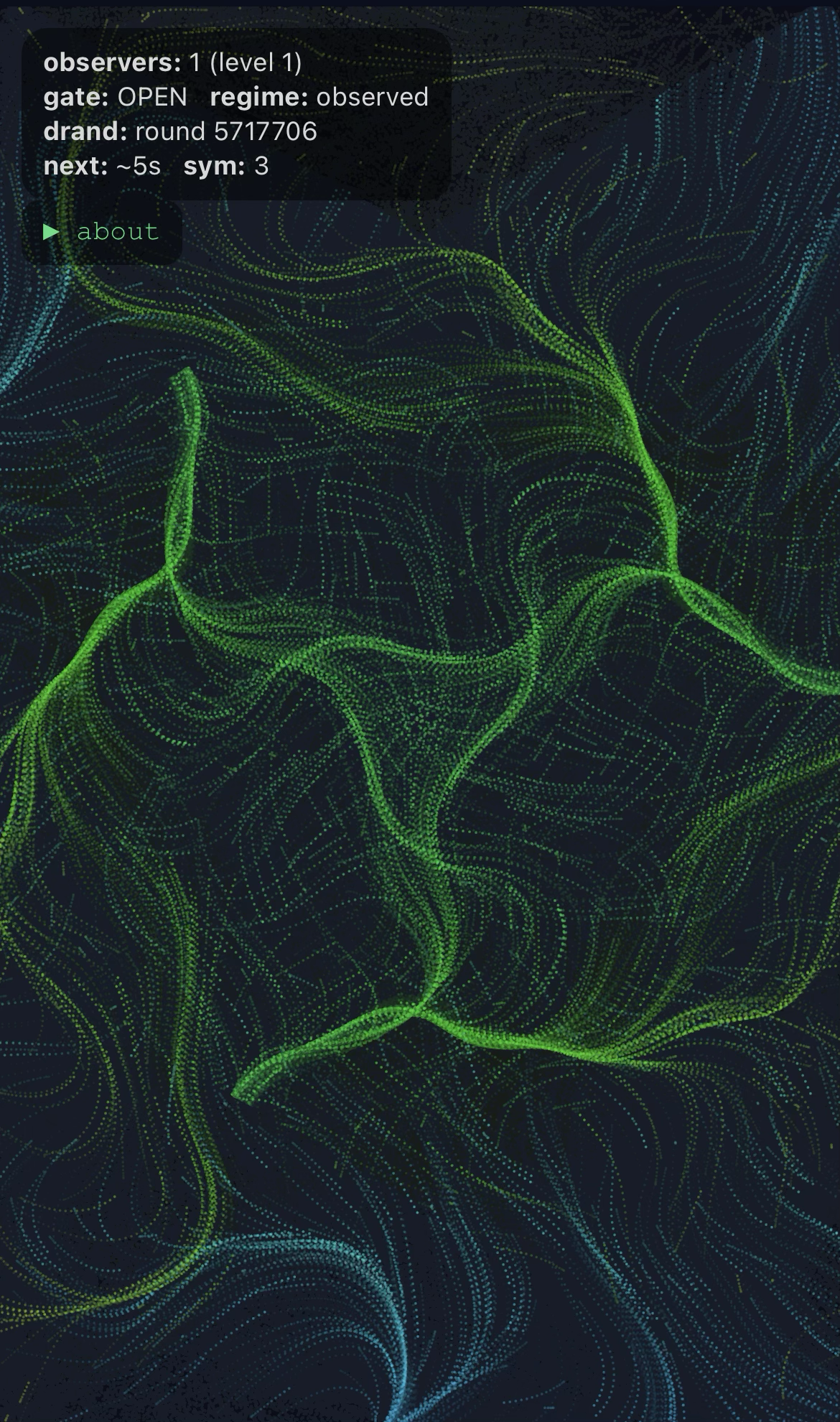
Color variation emerges from hue cycling based on time and particle position, particle life cycles adding oscillation, and the mutation seed indirectly affecting colors by changing flow patterns. The system doesn't need preset palettes—it discovers its own aesthetic through the mathematics of cryptographic randomness.
Conceptual Foundation
The Quantum Measurement Metaphor
The project draws structural inspiration from quantum measurement without claiming to model physical reality. In quantum mechanics, measurement collapses a superposition of states into a single outcome. The observer does not choose the outcome—they merely permit it to be revealed. Similarly, in this artwork:
- Without observation: The system exists in a continuous, unstructured state—color shifts, particles move, but no discrete events occur.
- With observation: The system collapses into new configurations at moments determined by external cryptographic randomness.
- Observation is presence, not control: Viewers cannot influence outcomes. They simply provide the condition that allows the system to receive external events.
Cryptographic Randomness as External Signal
Most generative art relies on pseudorandom number generators—deterministic algorithms that produce seemingly random sequences from a seed value. Observed Art takes a different approach by listening to drand, a publicly verifiable randomness beacon operated by the League of Entropy.
What makes drand different:
- Threshold cryptography: No single node controls the output. A minimum number of independent participants must cooperate to produce each random value.
- Unpredictability: The output cannot be predicted in advance or manipulated after the fact.
- Public verifiability: Anyone can independently verify the authenticity of each random value using cryptographic proofs.
The artwork does not generate randomness—it waits for it. Each drand output triggers a discrete state transition, redefining the visual field's parameters: noise scale, flow curvature, symmetry, particle density, and color evolution.
Observation Regimes
The system responds differently depending on how many observers are present:
| Observer Count | Regime | Behavior |
|---|---|---|
| 0 | Latent | System drifts continuously without external events. No drand synchronization. |
| 1–24 | Observed | Sharp, punctuated transitions. Each drand event triggers visible collapse. |
| 25+ | Crowd | Smoother, more fluid transitions. Increased complexity and visual richness. |
This reflects a core idea: outcomes are independent of observers, but observation governs when outcomes may be revealed.
Technical Architecture
System Components
The project consists of three interconnected layers:
- Frontend (Client): p5.js-based generative particle system with real-time connection to backend
- Backend (Server): Node.js/Express server polling drand and managing observer state
- External Signal: drand randomness beacon providing cryptographic events
Frontend: Generative Particle System
The visual field is produced by a flow field particle simulation implemented in p5.js. Thousands of particles follow vector fields generated by Perlin noise, creating organic, fluid motion patterns.
Key parameters controlled by drand mutations:
- Noise scale (0.002–0.02): Determines fine vs. coarse structure
- Curl (0.8–6.0): Controls spiral tightness vs. loose flows
- Symmetry (1–4 fold): Radial pattern complexity
- Drift & step: Particle speed and coherence
- Spawn rate & max particles: Density and visual weight
Backend: State Management and drand Integration
The server is built with Node.js and Express, managing three critical responsibilities:
- Polling drand: Every 3 seconds, the server fetches the latest random value from drand's public API
- Observer tracking: Counts live WebSocket and SSE connections to determine observation regime
- State broadcasting: Pushes updated state to all connected clients in real time
Observer measurement: An observer is defined as a live network connection. When someone opens the page, a connection is established and counted. When they leave, it disappears. There is no tracking, no identity, no interpretation of intent—only presence.
Connection Resilience
One of the most significant technical challenges was maintaining stable connections for extended viewing sessions. The system uses a dual-protocol approach with WebSocket (preferred) and Server-Sent Events (SSE) fallback.
The solution combines server-side keepalive (15-second heartbeat) with client-side automatic reconnection and stale connection detection. This ensures the countdown continues updating indefinitely with automatic recovery from temporary network issues.
Blockchain Provenance: Capturing a Collapsed State
On the evening of the project's completion, the work was minted as an NFT on the Manifold platform, capturing a specific moment in the system's evolution: "Direct Presence: drand round 5717467".
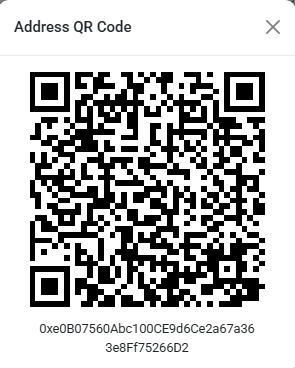
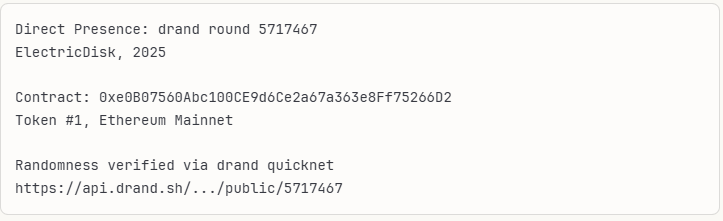
This blockchain record adds a profound layer to the conceptual framework:
Cryptographic provenance meets cryptographic ownership. The work is governed by verifiable randomness from drand (threshold cryptography), and now a specific instance of that randomness is permanently recorded on the blockchain (immutable ledger). The NFT is not a reproduction or derivative—it is one branch of the wavefunction, frozen at the moment of measurement.
Proof of concept made permanent. The NFT proves that the configuration shown existed at drand round 5717467. Anyone can verify this by:
- Checking the drand public record for round 5717467
- Confirming the blockchain transaction timestamp
- Validating that the visual state corresponds to that specific random seed
This creates a verifiable chain of provenance: drand produces randomness → system collapses into state → blockchain records collapsed state → NFT proves authenticity. Every link in this chain is cryptographically verifiable.
The live site continues evolving. While the NFT captures one frozen moment, the live system at directpresence.manus.space continues receiving new drand values, collapsing into new states, evolving probabilistically. The NFT is a historical record; the live site is the ongoing experiment. Together, they demonstrate the difference between measurement (NFT snapshot) and superposition (live evolution).
Development Journey with Manus AI
Initial Concept and Rapid Prototyping
The project began with a conceptual goal: create an artwork that measures observation directly and responds to cryptographically verifiable randomness. Manus AI helped translate this abstract concept into concrete technical requirements.
Within the first session, we had a working prototype with p5.js particle system generating aurora-like visuals, server polling drand every 3 seconds, basic WebSocket connection for state updates, and HUD displaying observer count, drand round, and countdown timer.
Iterative Refinement
The development process involved multiple rounds of refinement, each addressing specific user experience and technical challenges:
- Visual Polish: Implemented smooth parameter transitions, added collapse pulse visualization, refined color system
- Information Architecture: Added collapsible "about" section with comprehensive explanatory text
- Connection Resilience: Diagnosed SSE timeout issue, implemented keepalive heartbeat and automatic reconnection
- Edge Cases: Fixed countdown timer bugs, added exponential backoff for reconnection attempts
What Manus AI Enabled
Conceptual translation: Manus AI excelled at translating abstract ideas (quantum measurement, threshold cryptography) into concrete technical implementations.
Rapid iteration: The ability to quickly prototype, test, and refine was crucial. Manus AI handled the implementation details while I focused on conceptual coherence and user experience.
Problem diagnosis: When issues arose (countdown freezing, connection timeouts), Manus AI systematically investigated root causes, proposed solutions, and implemented fixes.
Key Insights and Lessons Learned
1. Observation as a Technical Primitive
The project demonstrates that observation can be measured directly through network connections. This isn't a metaphor or simulation—the system literally counts live connections and changes its behavior accordingly.
2. Cryptographic Randomness as Artistic Material
Using drand as the source of randomness fundamentally changes the nature of the work. Unlike pseudorandom algorithms, drand outputs are unpredictable, verifiable, and external. This creates a work that is genuinely non-deterministic.
3. The Importance of Connection Resilience
For a work that depends on real-time connections, reliability is paramount. The final implementation ensures automatic recovery from temporary network issues, stale connection detection, and graceful degradation.
4. Shared Signal, Local Drift
One of the most interesting emergent properties is the synchronization paradox: all observers receive the same drand values at the same moments (discrete events are synchronized), but the visual field evolves differently on each device due to local frame rates and timing.
Conclusion
Observed Art (Direct Presence) demonstrates that generative systems can be more than aesthetic engines—they can be measurement instruments that respond to real external signals. By integrating cryptographic randomness, direct observation measurement, and blockchain provenance, the work creates a complete loop: verifiable randomness → observable collapse → permanent record.
The project also highlights the power of AI-assisted development. Manus AI enabled rapid iteration from concept to production, handling technical complexity while preserving conceptual coherence. The result is a work that operates at the intersection of art, cryptography, distributed systems, and blockchain.
Most importantly, the work is genuinely non-deterministic. No one—not the viewers, not the artist, not even the system itself—knows what configuration will emerge next. The artwork waits for randomness from an external network, and when observation permits, it collapses into new states. It is a system that observes as much as it is observed.
The NFT minting completes the conceptual circle: a work about cryptographic verification is itself cryptographically verified. A work about discrete collapse events captures one such collapse permanently. A work about observation-dependent reality provides permanent proof that specific observations occurred.
Experience the Live Artwork →